Top Soccer Leagues in the World
Anúncios
Anúncios
The top soccer leagues are the engines of global football, the stages where the sport’s greatest players define their legacies and where billions of fans find their weekly rhythm.
From the English Premier League’s unmatched global reach to the tactical brilliance of Spanish La Liga and the rising intensity of Italian Serie A, each of the major leagues offers something distinct that no other competition can replicate.
Whether you are a lifelong EPL supporter, a new fan trying to understand the difference between the Champions League and the Leagues Cup, or someone exploring which competition offers the most compelling viewing experience, knowing how these leagues compare is the foundation of a deeper appreciation for the sport.
This complete guide breaks down the world’s top soccer leagues by standing, character, key clubs, and what makes each one worth following in 2026.
See Also
- Best football players in the world right now
- Top young football players to watch in 2026
- Most successful football clubs in history
- Best football stadiums in the world
- Football rules explained for beginners
How the World’s Top Soccer Leagues Are Ranked in 2026
Ranking the top soccer leagues in the world requires looking at multiple factors simultaneously — revenue, UEFA coefficient rankings, global viewership, squad quality, and the competitive dynamics that make each league distinct as a product.
No single metric tells the complete story. A league can rank first in revenue while sitting third in UEFA coefficients. A league can produce the world’s top individual club while lacking the depth of competition across the full table that defines another competition’s identity.
The framework used here combines financial standing, competitive prestige, European performance, global audience reach, and the quality of the narrative each league generates week to week — a holistic assessment that reflects how fans and analysts actually discuss these competitions in 2026.
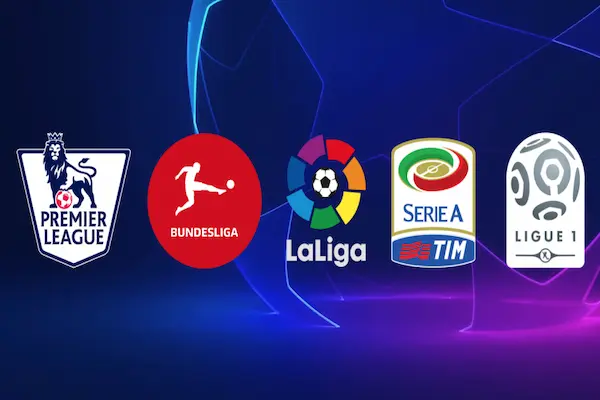
| League | 2026 Standing | Key Characteristic |
|---|---|---|
| English Premier League | #1 Globally | The richest league with €7.4 billion in revenue and the highest global viewership (218M+ social followers). |
| Spanish La Liga | #2 Historically | Home to the world’s highest revenue-generating club, Real Madrid (€1.16B). |
| Italian Serie A | #3 Climbing | Has recently overtaken the Bundesliga in technical rankings due to strong European tournament runs. |
| German Bundesliga | #4 Consistent | Boasts the highest average stadium attendance and financial sustainability of any major league. |
| French Ligue 1 | #5 Contender | Dominated by PSG, but fighting to keep pace with the financial “Big Four.” |
Beyond these five, several competitions are reshaping the global soccer landscape — and understanding the full picture means looking further than the traditional European elite.
The English Premier League — The #1 Soccer League in the World
The Premier League is the most commercially successful, most globally watched, and most financially powerful soccer league on the planet — and in 2026, no competing league comes close to matching its overall dominance across those three metrics simultaneously.
With €7.4 billion in annual revenue and a social media following that exceeds 218 million across its official channels, the EPL Premier League operates at a scale that makes every other domestic competition look like a regional product by comparison. Broadcast rights for the Premier League are sold in virtually every country in the world, with deals that fund squad budgets far exceeding what clubs in competing leagues can offer.
The competitive depth of the PL League is what defines its viewing experience week to week. Unlike La Liga — where two or three clubs have historically dominated the title race — the Premier League regularly produces title challenges from five or six clubs simultaneously, creating high-stakes matches across the entire season rather than concentrating drama into a handful of direct clashes between the same two or three teams.
Fixtures like West Ham vs. Liverpool, Arsenal vs. Brighton, and Tottenham vs. Chelsea carry genuine storylines and points implications that keep the table unpredictable from September through May — a dynamic that explains why the Peacock Premier League streaming deal in the US has become one of the most valuable sports rights in the American market.
- Top clubs: Manchester City, Arsenal, Liverpool, Chelsea, Manchester United, Tottenham Hotspur
- Season format: 20 clubs, 38 matchdays, top 4 qualify for the UEFA Champions League
- Key rivalry to follow: Arsenal vs. Tottenham (North London Derby), Manchester City vs. Liverpool
- Global reach: Broadcast in 189 countries; 218M+ combined social followers across official channels
Spanish La Liga — The Home of the World’s Greatest Club
La Liga holds its position as the world’s second-ranked soccer league on the strength of one defining advantage: it is the home competition of Real Madrid, the highest-revenue generating football club on the planet at €1.16 billion annually, and the most decorated club in Champions League history.
The primera league — as La Liga is known in Spanish — has historically been the breeding ground for the game’s most technically sophisticated football. The tactical systems developed and refined at Spanish clubs over the past two decades have influenced the way football is played globally, with the tiki-taka possession style pioneered by Barcelona and adapted by Spain’s national team producing three consecutive major international titles between 2008 and 2012.
La Liga’s primary competitive challenge in 2026 remains the persistent dominance of its two biggest clubs. Real Madrid and Barcelona have won the title so frequently that the race for third place — and the UEFA Champions League qualification spots below the top two — is often where the most genuinely competitive football in the second half of the season is found.
- Top clubs: Real Madrid, Barcelona, Atletico Madrid, Sevilla, Real Sociedad
- Season format: 20 clubs, 38 matchdays
- Defining characteristic: Home to the sport’s highest-revenue club and two of the three most globally recognized football brands
- Key rivalry: El Clásico — Real Madrid vs. Barcelona, the most watched club fixture in world football
Understanding which clubs have defined football’s history across these elite leagues adds depth to every match — our breakdown of the most successful football clubs in history provides the context behind why certain names carry the weight they do on the European stage.
Italian Serie A — The Climbing Competition
Italian Serie A has undergone a genuine competitive and financial renaissance in recent years, and its climb from fourth to third in the UEFA technical coefficient rankings reflects real improvements in how Italian clubs perform in European competition — not just a statistical fluctuation.
Serie A’s identity in 2026 is defined by tactical sophistication, physical intensity, and a depth of interesting clubs that goes beyond what most casual observers expect. While Juventus and Inter Milan remain the dominant forces in terms of resources and historical success, clubs like Napoli, AC Milan, AS Roma, and Atalanta have all demonstrated the capacity to win the league or mount deep European runs in recent seasons.
For US-based fans, Serie A on ESPN has become significantly more accessible — and Paramount+ holds the exclusive streaming rights to every Serie A match in the American market, making it one of the most straightforward competitions to follow from outside Europe.
- Top clubs: Inter Milan, Juventus, AC Milan, Napoli, AS Roma, Atalanta
- Season format: 20 clubs, 38 matchdays
- Defining characteristic: Rising UEFA coefficient ranking; tactical complexity and physical intensity across the full table
- How to watch in the US: Paramount+ (exclusive streaming rights for Serie A)
German Bundesliga — The Most Sustainable Soccer League in Europe
The Bundesliga’s standing as the fourth-ranked major soccer league in Europe masks what is arguably its most important distinction: it is the most financially sustainable and fan-friendly top-tier competition on the continent, operated under a 50+1 ownership model that prevents external investors from taking majority control of clubs.
The practical result of this structure is the highest average stadium attendance of any soccer league in the world — a figure that reflects genuine community ownership and supporter investment rather than the commercially driven artificial inflation that occasionally distorts attendance data elsewhere.
Bayern Munich’s domestic dominance has been the Bundesliga’s primary competitive challenge for over a decade, winning the title in eleven of the last twelve seasons. That consistency at the top has led some analysts to suggest the league’s most compelling football happens in the race for Champions League qualification spots rather than the title itself — but Bayer Leverkusen’s title triumph in 2024 demonstrated that dominance can be broken when the right club assembles the right squad at the right moment.
- Top clubs: Bayern Munich, Borussia Dortmund, Bayer Leverkusen, RB Leipzig, Borussia Mönchengladbach
- Season format: 18 clubs, 34 matchdays
- Defining characteristic: Highest average stadium attendance globally; 50+1 ownership protecting supporter influence
- Key rivalry: Der Klassiker — Bayern Munich vs. Borussia Dortmund
French Ligue 1 — The Ambitious Fifth Major Soccer League
Ligue 1 occupies a complicated position in the hierarchy of European soccer leagues — a competition with genuine world-class individual talent and one club of extraordinary financial power, but still fighting for parity with the financial “Big Four” leagues in terms of overall broadcast revenue and European performance.
PSG’s dominance of Ligue 1 is historically unmatched in any major European league — winning the title in all but two of the last thirteen seasons. While this creates a predictable domestic landscape, the club’s investment in elite talent has consistently produced some of the most technically gifted squads in European football, with players of the caliber of Kylian Mbappé (before his move to Real Madrid), Neymar, and Lionel Messi all having appeared in Ligue 1.
Beyond PSG, clubs like Olympique de Marseille, Olympique Lyonnais, Monaco, and Lille have all demonstrated the capacity to challenge domestically and perform meaningfully in European competition — keeping the league from being a pure one-club showcase at its lower competitive levels.
- Top clubs: Paris Saint-Germain, Marseille, Lyon, Monaco, Lille
- Season format: 18 clubs, 34 matchdays
- Defining characteristic: PSG’s financial dominance domestically; growing international profile through marquee player signings
- Key challenge: Closing the revenue gap with the EPL, La Liga, Serie A, and Bundesliga
The UEFA Champions League — The Most Prestigious Club Competition in Soccer
No club soccer competition commands the respect, viewership, or emotional investment of the UEFA Champions League — and understanding how it relates to the domestic leagues is essential for any fan who wants to follow European football at its highest level.
The soccer Champions League — often referred to as the UCL soccer competition — brings together the top-performing clubs from every UEFA member association’s domestic league, with the number of qualifying spots allocated to each country determined by the UEFA coefficient ranking of that nation’s league.
In practical terms, this means the Champions League field in any given season is drawn primarily from the English Premier League, La Liga, Serie A, and the Bundesliga — the four leagues whose clubs consistently generate the most UEFA coefficient points through deep European runs.
The format in 2026 continues the expanded league phase introduced in the 2024–25 season, where 36 clubs each play eight group phase matches before the knockout rounds begin, replacing the previous six-match format and creating even more high-profile fixtures in the competition’s early stages.
- Format: 36-club league phase, followed by knockout rounds through to the final in late May
- Most decorated club: Real Madrid (15 titles)
- Viewing in the US: Paramount+ holds exclusive streaming rights for all UEFA Champions League matches
- Key distinction from domestic leagues: Single-leg knockout matches (except the final) from the Round of 16 onward, creating extreme pressure on every match result
The players who define Champions League nights are the same players who will carry the weight of their nation’s hopes at the 2026 World Cup — and following the top young players entering their prime this season gives you a clear picture of who is building toward both stages simultaneously.
Other Soccer Competitions Worth Following
The five major European leagues and the Champions League are not the only soccer competitions producing compelling football in 2026 — and expanding your viewing beyond the traditional elite opens up a genuinely rewarding range of styles, stories, and stakes.
- UEFA Europa League: The second-tier European club competition, which has historically produced some of the most unpredictable knockout results in continental football. Clubs from leagues outside the Big Five regularly reach deep into this competition.
- UEFA Conference League: The third tier of European club competition, introduced in 2021. It has given clubs from smaller leagues meaningful European experience and produced genuine moments of national celebration for nations rarely represented in elite European football.
- UEFA Nations League: The international competition that replaced meaningless friendly matches with competitive group stage football between national teams. The Nations League now directly influences World Cup and European Championship qualification pathways.
- MLS (Major League Soccer): The Apple MLS deal — giving Apple TV+ exclusive rights to every MLS match with no blackouts — has raised the league’s profile significantly. Pro MLS has invested heavily in high-profile signings and expansion clubs, and the competition is developing at a pace that is accelerating year by year. The Apple MLS streaming arrangement makes it the most accessible top-division soccer league for US-based fans in terms of pure coverage completeness.
- Leagues Cup: The cross-border competition between MLS and Liga MX clubs, which has generated some of the most entertaining summer soccer in North America and will continue to grow in significance as the 2026 World Cup raises soccer’s profile in the region.
- NWSL / IWSL Soccer (Women’s Leagues): The National Women’s Soccer League and its international equivalents have grown dramatically in profile, viewership, and quality. IWSL soccer and Women’s Super League matches now regularly draw attendance figures and broadcast audiences that rival lower-division men’s football in the same markets.
Fantasy Football and Following Soccer Leagues in 2026
One of the most effective ways to deepen your engagement with any soccer league is through fantasy football — and the ecosystem around fantasy league competitions has matured significantly in 2026.
The official Premier League Fantasy Football game remains the most popular fantasy soccer competition globally, with millions of active managers tracking player statistics, injury updates, and fixture difficulty ratings throughout the season. Its accessibility has made the EPL the default entry point for fans new to following soccer leagues systematically.
Fantasy football league formats also exist for La Liga, Serie A, and the Champions League, each with their own scoring systems and roster management mechanics. For fans who want to extend their engagement beyond passive viewing, these games turn every match into a personal stakes event — even fixtures between clubs you do not actively support.
Premier League betting markets — alongside fantasy league management — have also become a significant part of how fans in the US engage with EPL Premier League fixtures, though responsible engagement and awareness of local regulations always applies.
The biggest rivalries in football history that play out across these leagues every season are what give fantasy football and match viewing their emotional core — because the results matter most when the history between the clubs involved gives them a weight that goes beyond three points in a table.
Final Verdict: Which Soccer League Is Right for You?
After reviewing every major competition, the answer depends entirely on what kind of football experience you are looking for.
If you want the most competitive week-to-week action with genuine title uncertainty from September through May, the English Premier League is the clear answer — and Peacock’s Premier League streaming rights make it more accessible in the US than ever before.
If you want elite technical football and the world’s most prestigious clubs, La Liga provides an unmatched combination of Real Madrid’s dominance and Barcelona’s global identity — plus the best individual player showcase of any domestic competition.
If you want tactical depth and rising European prestige, Serie A on ESPN and Paramount+ delivers a product that is more tactically sophisticated than most casual fans expect and increasingly competitive at the top of the UEFA rankings.
If you are in the US and want complete domestic coverage, the Apple MLS deal makes Major League Soccer the easiest professional soccer league to follow with zero blackouts — and the quality of the product is improving with every transfer window.
The global soccer landscape in 2026 has never offered more options, better streaming access, or more compelling storylines across multiple competitions simultaneously.
Pick your league, pick your club, and enjoy every match from the first whistle to the last.
Want to keep exploring the world of football beyond the league standings? Our sports section covers player rankings, rivalry guides, tournament previews, and everything else that makes following soccer the most rewarding sporting habit you can build.