Loading...

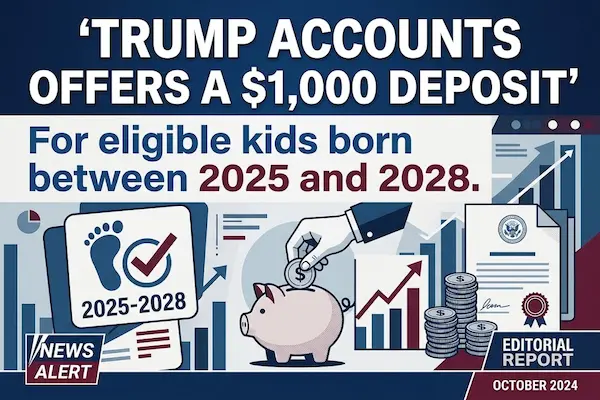
$1,000 child savings account

A new federal program is giving eligible children a $1,000 head start.

$1,000 Child Savings Account
HOW TO GET IT

You will remain in the same website

Most parents haven’t heard the full details yet, and the ones who have often confuse it with something else, like a tax credit or a one-time check. It’s neither. It’s a dedicated, tax-advantaged savings account that grows with your child.

The account has to be opened before the deposit lands. That single step trips up a lot of families who assume the money shows up automatically once a baby is born, which delays when the funds start growing.

Once it’s set up, the account works quietly in the background for years, growing tax-deferred until your child turns 18. Understanding the basics now means you don’t miss the window to get it started.

Informative content. We are not affiliated with the U.S. Treasury or any government agency. This page does not process deposits or collect Social Security numbers.

Who actually qualifies

Children must be U.S. citizens with a Social Security number, born between January 1, 2025 and December 31, 2028. There’s also a separate philanthropic $250 deposit available to some children born earlier, in select lower and middle-income ZIP codes.

Only one account is allowed per child, so duplicate elections for the same child are automatically rejected.

How contributions work beyond the government deposit

Parents, grandparents, or other relatives can add up to a combined $5,000 per year on top of the federal deposit. Employers can also contribute, with their portion capped separately and counting toward that same annual limit.

None of these added contributions trigger gift tax filing requirements, since they count toward the standard annual exclusion for gifts.

What happens to the money over time

Funds are invested and grow tax-deferred from the time the account opens until the child turns 18. At that point, the account converts into a traditional IRA-style account, meaning it’s built for long-term growth rather than near-term spending.

Withdrawals before 18 are generally restricted, with limited exceptions like certain rollovers or excess contribution corrections.

How this compares to a 529 plan

A 529 plan is designed for education expenses specifically, while this new account functions more like a retirement account that happens to start decades early. Many families end up using both, since they serve different purposes and don’t compete for the same dollars.

Frequently asked questions

Is the $1,000 automatic once my child is born?

No. The account needs to be opened and the election filed first. The deposit is applied after that step, not automatically at birth.

Can I use this money for college instead?

The account isn't designed for near-term education expenses the way a 529 plan is. It converts to an IRA-style account at 18, built for longer-term growth.

What if my child was born before 2025?

They generally don't qualify for the $1,000 federal deposit, but some children born 2016 to 2024 in certain ZIP codes may qualify for a separate $250 philanthropic contribution.

Does this cost anything to set up?

There's no cost to elect the account itself. Ongoing account or investment fees depend on the trustee managing the funds.

This content was written by:

Luiz Maciel

Luiz Maciel

Communication enthusiast, Luiz specializes in developing content for websites.

Our site serves as an information hub, providing impartial and reliable content to the public.

All content from PDNI Online is protected by property laws. Unauthorized reproduction is strictly prohibited.

LEGAL NOTICE: PDNI Online technology, applications, careers, and general news. We have no affiliation with the brands mentioned and never request personal or banking information. Our mission is to inform our readers.

HOW TO GET IT

You will remain in the same website