Low income phone and internet – Lifeline benefits
Learn low income phone and internet Lifeline benefits in 2026, eligibility, discounts, provider tips, and recertification rules.
Anúncios
Low income phone and internet: what Lifeline benefits actually give you in 2026
Lifeline gives you a monthly discount that is applied directly to your bill, and you choose where to use it.
Anúncios
In most cases, you can apply the Lifeline benefit to either phone or internet, but not both at the same time.
For many people, that single choice is the make-or-break moment, because it decides whether you prioritize mobile access or home broadband stability.
The standard Lifeline discount is up to $9.25 per month.
If you live on qualifying Tribal lands and meet the requirements, the enhanced discount can be up to $34.25 per month.
If you prefer a voice-only plan, there is still a smaller Lifeline support amount of $5.25 for standalone voice service that remains available through at least November 30, 2026 under the current pause of the phase-out rules.
That voice-only detail matters if you live in an area where mobile data coverage is weak, or if you simply need a reliable basic line and nothing else.
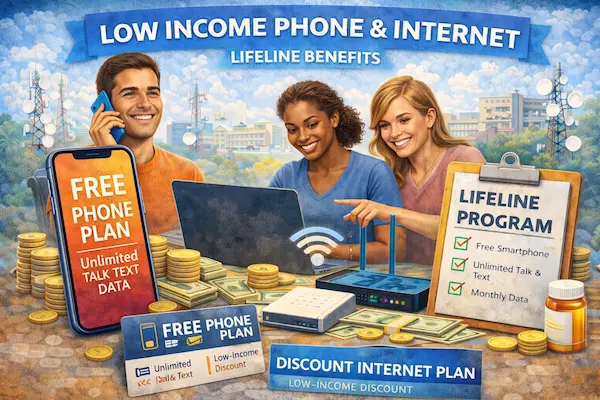
Quick clarity: Lifeline is a monthly discount benefit, and “free phones” are usually provider promotions that can change by inventory and ZIP code.
Low income phone and internet eligibility: the two ways you can qualify
You typically qualify for Lifeline in one of two ways, and you only need one path to be eligible.
You can qualify based on income, or you can qualify through program participation.
If you’re trying to move fast, choose the path that you can prove most clearly with documents you already have.
Income-based qualification for low income phone and internet
For income-based eligibility, your household income generally needs to be at or below 135% of the Federal Poverty Guidelines.
For 2026, the commonly used table for the 48 states and D.C. is shown below, and Alaska and Hawaii have higher limits.
| Household size | Annual income (135% FPL) | Monthly income |
|---|---|---|
| 1 person | $21,546 | ~$1,795 |
| 2 people | $29,214 | ~$2,434 |
| 3 people | $36,882 | ~$3,073 |
| 4 people | $44,550 | ~$3,712 |
If you live in Alaska or Hawaii, don’t assume you’re over the limit based on the table above, because those states use different figures.
The best move is to check your state’s official Lifeline eligibility table and apply with the correct category for where you live.
Program-based qualification for low income phone and internet
You can also qualify if you or someone in your household participates in certain assistance programs.
Common qualifying programs include SNAP, Medicaid, SSI, Federal Public Housing Assistance, and Veterans Pension and Survivors Benefit.
This path can feel easier because you may already have a benefit letter or proof of participation available quickly.
Even if you qualify through a program, you may still need to provide documentation, so it helps to have your proof ready before you begin the application.
Low income phone and internet plan minimums: what providers must meet in 2026
One of the most reassuring parts of Lifeline is that providers must meet minimum service standards.
That means you’re not supposed to get a “barely works” plan just because you’re using a discount benefit.
For early 2026 standards that have been widely referenced in official program guidance, the minimums include at least 4.5 GB of mobile data for data plans, at least 1,000 minutes for mobile voice plans, and home internet minimums that include at least 25/3 Mbps speeds with a large data allowance that has been referenced around 1,280 GB for fixed broadband usage standards.
Your provider can offer more than the minimum, and many do, but the minimum gives you a baseline for comparison when marketing language gets vague.
If a plan description feels unclear, ask the provider directly for the plan’s data amount, voice minutes, and any throttling rules in writing.
Low income phone and internet providers: who you’ll see most often in 2026
When you search for help, you’ll often see the same brands repeatedly, because they operate in many states.
You might also see people call them “government phone companies,” but it’s important to remember these are private companies participating in a regulated program.
In many areas, popular options people compare include SafeLink Wireless, AirTalk Wireless, TruConnect, Assurance Wireless, and Q Link Wireless.
The smartest approach is to compare only the providers that actually serve your ZIP code, because a provider can be famous online and still not operate where you live.
Also, do not choose based on the phone promo alone, because the phone can change, but the day-to-day service experience is what you’ll live with.
How to compare providers without getting overwhelmed
-
- Coverage where you live, because a “great plan” is useless if you have no signal at home.
- Data amount and throttling, because some plans slow down after a threshold.
- Hotspot rules, if you need to connect a laptop for school or job applications.
- Customer support quality, because support matters when recertification or SIM issues happen.
- BYOP support, if you want to keep your current phone and avoid low-storage devices.
Low income phone and internet and the “one per household” rule
Lifeline has a strict one per household rule, and this is one of the most common reasons people get denied or later de-enrolled.
A household is typically defined as people at the same address who share income and expenses.
So if you and someone else share bills and finances, you generally count as one household, and only one Lifeline discount can apply.
If you live with roommates or other adults and you truly keep finances separate, you may qualify as separate households, but you may need to document that separation through a household worksheet process.
The best way to protect yourself is to be accurate and consistent, because duplicate benefits at the same address are something the program actively checks for.
Low income phone and internet recertification: what the 2026 “audit” warnings really mean
In 2026, you may hear about “program integrity” sweeps or audits, and it can sound scary at first.
What it usually means in practice is that the program will periodically ask you to confirm that you still qualify, and you must respond on time.
If you ignore recertification messages, you can lose the benefit even if you still qualify, simply because the system could not confirm your status.
If your eligibility changed, like you no longer receive SNAP, you may need to re-qualify through income or another program, or update your documentation quickly.
The most important habit is this: open every Lifeline-related letter, email, or text, and respond immediately if it asks you to confirm eligibility.
If you’re helping someone else stay enrolled, you can save them a lot of stress by setting reminders and helping them keep documents organized in one place.
Low income phone and internet “use it or lose it”: how to avoid surprise disconnection
If your service is free or heavily discounted, you generally must use it periodically to keep it active.
A common rule you’ll see is that you must use the service at least once in a 30-day period, such as making a call, sending a text, or using data.
If you don’t, you may get a warning notice and then lose service if inactivity continues.
This rule hits hardest for older adults or anyone who rarely uses a phone, because they may not realize they need to “ping” the service monthly.
A simple monthly reminder to send one text or make one short call can prevent a painful disruption later.
Low income phone and internet and “free phones”: what’s realistic in 2026
You’ll see a lot of ads promising a free iPhone or a free Samsung, and some providers do offer device promotions, often refurbished or older models.
Still, you should treat device offers as a bonus, not the main reason to enroll, because inventory changes constantly and can vary by ZIP code.
If you want a better experience, consider BYOP, which means Bring Your Own Phone, because a phone you already trust can be better than a random device shipped during a promotion.
If you do choose a phone promotion, confirm what model you will receive in writing, and confirm any shipping or upgrade costs before you submit sensitive documents.
Be especially cautious of ads promising brand-new “Free iPhone 15 or 16” style claims, because current-generation devices are not a realistic standard free giveaway in this program category, and those ads can be used to collect personal data.
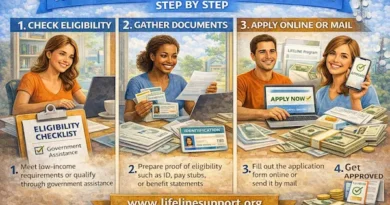
Low income phone and internet application: the easiest order that prevents mistakes
The easiest way to apply is to follow the official flow, in the right order, so you don’t upload documents repeatedly to multiple companies.
First, you confirm eligibility through the official Lifeline verification process for your state.
Second, you use the official tool that shows which providers operate in your ZIP code.
Third, you compare plan details and decide whether you want the benefit on phone or internet, because you typically can’t apply it to both at the same time.
Fourth, you enroll with the provider you chose and keep your confirmation details saved.
Finally, you use the service regularly and respond to recertification quickly so your benefit stays active.
That flow keeps you in control and reduces the chances of getting stuck in a loop where you applied but can’t tell what happened next.
Reminder: This article is independent and informational.
We do not control eligibility decisions, provider availability, plan terms, inventory, verification outcomes, or enforcement for any agency or third party mentioned.