Government phone companies – Lifeline providers
Compare government phone companies offering Lifeline, check eligibility, avoid scams, and enroll using official steps.
Anúncios
Government phone companies explained: what Lifeline really is
The Lifeline program is a federal benefit that makes communications service more affordable for eligible low-income households.
Anúncios
You receive a monthly discount, and you choose a participating provider that offers service in your area.
That’s why you’ll see so many names in ads, because multiple carriers can offer Lifeline plans, but only in the places where they’re authorized and operating.
One important detail that protects you is that Lifeline is regulated with clear eligibility rules, documentation requirements, and a strict limit on how many discounts a household can receive.
When you understand those rules, you’re much less likely to get pressured into something that doesn’t fit your situation.
Government phone companies and Lifeline providers: the brands you’ll hear most
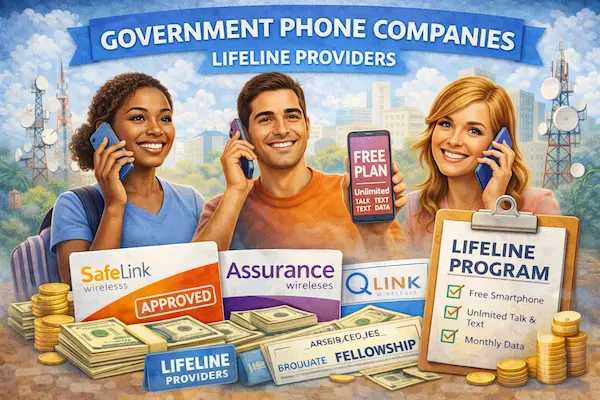
In 2026, you’ll still hear a handful of Lifeline providers come up again and again because they operate in many states and have established enrollment systems.
Here are common examples you may see, with the most important thing to remember about each one.
Availability and plan details vary by state, so treat these as comparison starting points, not universal promises.
-
- SafeLink Wireless is a long-running Lifeline brand and is associated with TracFone brands, with network coverage that can vary by market and underlying agreements.
- Assurance Wireless markets service on the T-Mobile Network, and plan features can include data, talk, and text packages that vary by state.
- TruConnect emphasizes simple digital enrollment in many markets and commonly advertises international calling options alongside Lifeline service, depending on the plan and state.
- Life Wireless offers Lifeline-supported service in participating states, and plan amounts, data caps, and BYOP options can vary by location.
- Q Link Wireless is a name many people recognize from past Lifeline marketing, but the safest approach is to verify current availability for your ZIP code before you assume it’s an option.
If you want the simplest “rule” while comparing providers, use this one.
Only compare providers that appear as available for your ZIP code in an official provider search tool, and only enroll using official application pathways.
Government phone companies eligibility: how you qualify in 2026
To qualify for Lifeline, you generally need to meet either program-based eligibility or income-based eligibility.
You don’t need to qualify in both ways.
You just need one valid pathway, plus the required documentation for verification.
Program-based qualification
You can qualify if you or someone in your household participates in a qualifying program.
Common examples include SNAP, Medicaid, SSI, Federal Public Housing Assistance (FPHA), and Veterans Pension and Survivors Benefit.
If you live on qualifying Tribal lands, additional Tribal-specific programs can also qualify you, such as Bureau of Indian Affairs General Assistance, Tribally-Administered TANF, Tribal Head Start in specific circumstances, and Food Distribution Program on Indian Reservations (FDPIR).
Income-based qualification
If you qualify by income, your gross household income generally must be at or below 135% of the Federal Poverty Guidelines, and the exact limit depends on household size and state category.
Here are the official income limits for 135% of the 2026 Federal Poverty Guidelines for the 48 contiguous states, D.C., and territories.
| Household size | 2026 annual income limit (48 states & D.C.) |
|---|---|
| 1 person | $21,546 |
| 2 people | $29,214 |
| 3 people | $36,882 |
| 4 people | $44,550 |
If you live in Alaska or Hawaii, the limits are higher, and you should use the official table for those locations.
Also, don’t panic if your income is close to the line.
The verifier can tell you what documentation is acceptable, and sometimes a single missing document is the only reason an application stalls.
Government phone companies “one per household” rule: the mistake that gets people kicked out
The Lifeline program follows a strict one per household rule.
A household is generally defined as people at the same address who share income and household expenses.
So if you and another adult truly share money and bills, you usually count as one household, and you can only have one Lifeline discount total.
If you live with roommates or other adults and you keep finances separate, you may qualify as separate households, but you may be asked to complete a Household Worksheet to explain the situation.
This is where you protect yourself by being accurate and consistent, because the system is designed to stop duplicate benefits at the same address.
Quick mindset shift: Lifeline isn’t “one phone per address.”
It’s “one discount per household,” and the household definition is about shared finances.
Government phone companies discount amounts: what you actually get
The standard Lifeline discount is up to $9.25 per month for eligible subscribers.
If you live on qualifying Tribal lands, the discount can be up to $34.25 per month, and there may be additional support for certain connection charges under specific rules.
Your provider’s plan determines what that discount looks like in real life.
In some places you’ll see “free” plans where the discount covers the full cost of a basic plan.
In other places, you’ll see reduced-price plans where you pay a remainder after the discount is applied.
That’s why comparing a few providers in your ZIP code matters, even if all of them are “Lifeline providers.”
Government phone companies application: how to apply the right way
If you want to avoid the messy route, follow the official verification pathway first, then choose your provider.
This keeps you from re-submitting documents multiple times to multiple companies.
-
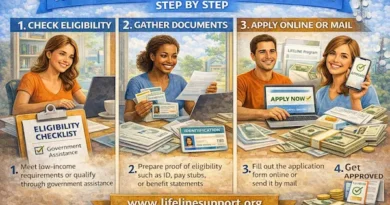
- Check eligibility through the National Verifier using the official Lifeline portal, and follow the prompts for income or program qualification.
- Gather documents once, such as a benefit letter, program card, or income proof like pay stubs or a tax document, depending on how you qualify.
- Use the “Companies Near Me” provider search to see which Lifeline providers operate in your ZIP code.
- Compare the plan details that matter, like data amount, hotspot rules, network coverage in your area, and whether you can Bring Your Own Phone.
- Enroll through an official enrollment method, and save confirmation numbers, emails, and screenshots so you can prove what you submitted.
One extra detail that can save you time is this.
Some states have special processes or state-specific pathways, so if you’re told your state has a different enrollment portal, follow that instruction rather than forcing a national workflow.
Government phone companies rules you can’t ignore: “use it or lose it”
If your Lifeline service is free, you generally must use it at least once every 30 days to keep it active.
Using it can be as simple as making a call, sending a text, or using data, depending on the service type.
If you don’t use it, you may receive a notice and then lose service if you still don’t use it within the stated timeframe.
This rule exists to prevent dormant lines from staying active indefinitely while others wait for service capacity and administrative processing.
So if you’re helping a parent, a grandparent, or someone who rarely uses a phone, set a simple reminder once a month so the benefit doesn’t get cut off unexpectedly.
Government phone companies comparison checklist: how you pick the right provider
When you compare Lifeline providers, you want to focus on what changes your day-to-day experience.
Marketing promises are easy to print.
Coverage, usability, and plan rules are what you actually live with.
-
- Coverage where you live and work, not just national coverage claims.
- Data amount and throttling behavior, especially if you use maps, video, or hotspot.
- Bring Your Own Phone compatibility, because an unlocked phone you already trust can be better than a random device offer.
- Customer support channels, like whether you can get help online, by chat, or by phone without endless hold times.
- Recertification and document re-checks, so you know what happens yearly and what triggers extra verification.
If you’re the kind of person who wants a quick shortcut, pick the provider that checks these three boxes first.
It’s listed as available for your ZIP code, it has stable coverage where you actually spend time, and it gives you plan rules in writing without dodgy fine print.
FAQ
Are “government phone companies” really run by the government?
No. They’re private companies that participate in the Lifeline benefit program, which is federally regulated and verified through official systems.
Can you get more than one Lifeline phone if you live with other adults?
Only one Lifeline discount is allowed per household, and a household is generally defined by sharing income and expenses.
If you live with other adults and you keep finances separate, you may need a Household Worksheet to document that you are separate households at one address.
Do you automatically qualify if you have Medicaid or SNAP?
Having Medicaid or SNAP is a common qualifying pathway, but you still need to complete verification and provide acceptable proof when requested.
Can you lose Lifeline if you don’t use the phone?
Yes. If the service is free, you generally must use it at least once every 30 days to keep it active, or you may be de-enrolled after notice steps.
Reminder: This article is independent and informational.
We do not control eligibility decisions, provider availability, plan details, verification outcomes, or program enforcement for any agency or third party mentioned.