Top 15 Apps for Musicians
Musicians and singers of any skill level can benefit from the technology that is available on the devices within our pockets. We’ve created a list of what we believe are the 15 best apps for musicians. Check out!
Anúncios
With the technology available today, we can access everything we need as long as we are connected to the internet. Along with these advances came a world of its own: the world of apps.
Anúncios
What started out as a simple and practical environment for games, useful tools and weather apps, quickly became a universe that now depends on apps in every industry and in every sector.
And this was no different with the music industry. One of the most profound ways technology has benefited the music community is by creating apps for musicians.
Whether you’re a budding singer, a seasoned pianist, or hobbyist, there are music apps for everyone. Whether you’re downloading a music learning app, or just to help you keep practicing your scales, we’ve listed our favorites below.
Here are what we think are the top 15 apps for musicians
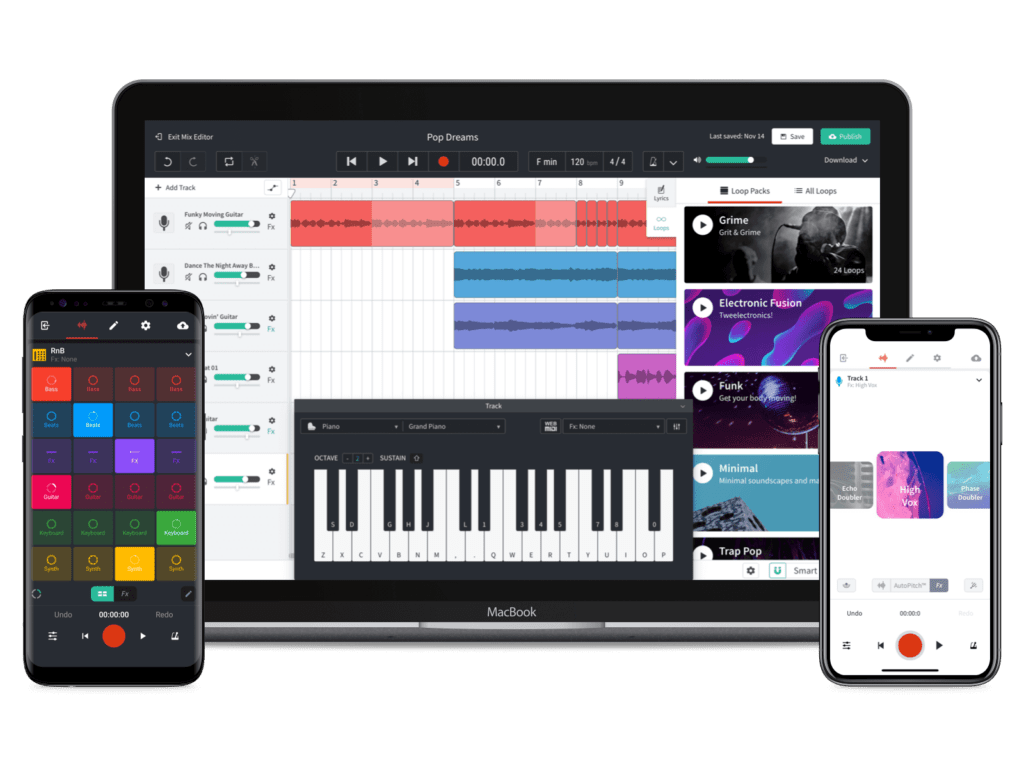
1. Moises App
Moises is the perfect example of an app to improve your musical skills. You can remove the vocals, isolate the part you are trying to learn, speed it up or slow it down, change the pitch or tempo, or even visualize the chords. The Moises App is the best choice for learning music, whether vocal or instrumental, or even trying something new!
Available on the Web, App Store and Play Store, there is a free version and a Premium subscription for just R$16.90 per month!
2. Apps for Musicians – Yousician
Yousician is one of the most popular music apps. With the ability to choose between guitar, piano, bass, singing or ukulele, it listens as you play and gives you real-time feedback. The musician app has over 1500 exercises and videos covering all types of skills. You can also follow up with guided lessons so you can learn at your own pace.
Available on the App Store and Play Store, the monthly subscription costs $9.99.
3. Garageband
Garageband is a very popular iOS-only app used by many entry-level musicians. It is essentially a turnkey music studio. With a variety of touch instruments, it’s very easy to use and a great starting point for beginners.
Free for iOS users.
4. SingTrue
Their slogan says it all: “SingTrue can teach anyone to sing, even if you think you’re deaf.” First you listen, then you sing, and then you correct if you have something that can work. It’s linked to interactive music exercises, and the app itself has been vetted by one of the world’s top vocal teachers.
Compatible with both Apple and Android, it is free to download.
5. Apps for Musicians – Single
Another great app for learning to sing is Singeo! It offers online singing lessons designed for anyone who wants to learn to sing. You can also count on a singing teacher to support you throughout your journey.
The goal is for you to be able to find out how your voice works to sing with confidence, at a price of $10.58 per month. They also offer a 90-day money-back guarantee if you are not satisfied with their service.
Compatible with both Apple and Android, this is a great option for you who want to develop your voice!
6. Tiny Piano
Tiny Piano is exactly what it sounds like: a piano ready to be played on both iOS and Android.
With over 400 songs to practice with, the main focus of the app is having fun! If you aim to practice scales or other simpler skills while having fun, this app is for you. You control the time and decide if you want to go fast or slow.
The app is free.
7. Apps for Musicians – Simply Piano
This app is a fun and fast way to learn piano. It works by placing your mobile device on your piano and it triggers when you start playing, from there it will immediately recognize what you are playing and can give you instant feedback. If you don’t have a piano to play, that’s not a problem. Simple Piano also offers touch strokes that allow you to turn your device into a keyboard, right on the screen.
Compatible with both Apple and Android, the subscription costs $9.99 per month.
8. Simply Guitar
Like Simply Piano, Simply Guitar is a very popular app among guitar students. As you play, it picks up sound through your device’s microphone and gives you real-time feedback. He teaches fundamental things through tutorials such as fingering techniques, chords, guitar tuning and more. Library songs and activities are updated regularly.
Compatible with iPhone and Android, subscription costs $9.99 per month.
See also: Series and Movies about Music: 9 Tips to Watch Now!
9. Drume
Of all the music apps available for learning to play the drums, Drumeo is certainly at the top! It was designed to be a drum lessons platform. From hand and foot technique to creative drumming, to playing along with songs, adjusting speed and resistance, dynamics, to almost any musical style, Drumeo has activities for it all!
Taught by world-renowned teachers, the lessons in this app are available on both iOS and Android. While there are different subscription options, you can pay for specific classes, varying the price according to your needs.
10. Violin: Magical Bow
Violin: Magical Bow was designed to make the violin as fun as any other instrument. By simulating a “real” violin, you can play notes, learn chords, and most importantly, have fun while you play.
It’s available on the App Store and Play Store, and it’s free to download, but it costs $2.99 to unlock each song.
11. Apps for Musicians – iBone
In the same vein of simulating a single instrument, the iBone works like a pocket trombone. The realism of the application is given by the possibility that you can tap or blow to make a sound, slide your finger to change the tone, and raise and lower the bell to change the volume.
The app covers the standard two and a half octave range that a trombone normally carries. You can choose to accompany the lead trombone or take a solo. Oh, if you don’t know what you’re doing, don’t worry! The Bone robot will guide you and point out what to do.
On both iOS and Android, you can play up to 7 free songs before buying more.
12. Easy Music
If you have kids at home who want to be introduced to the world of music, this is the perfect app for you. In it, children will learn to recognize notes, pitch, rhythm, melody, and can try different instruments.
No theory is needed in this lively world of fun, where interactive games serve to explore the musical universe and learn fundamental music-related skills.
Available on both the App Store and Play Store, this app costs $3.99 for a one-time payment.
13. Music Theory Helper
Music Theory Helper is a music learning app developed for Android system only. It makes the study of something very complex into something much simpler to manage.
You’ll learn things like chords, circles of fifths, note intervals, scales, symbols, along with multiple exercises to put your learning to the test. The goal is to provide an experience that is easy to understand and understand the concept of music theory.
As of the writing of this article, the app is free to download.
14. Tempo – Music Video Maker
For creators who want to add some fun and excitement to their music, we recommend using Tempo – Music Video Maker. Not only can you add video to your song, but you can also create a lyric video if you prefer.
With popular themes, a variety of music, transitions, filters and other effects, the app is free for both iOS and Android. There’s also a premium membership if you want to unlock everything it has to offer.
15. SoundCue
And last but not least, SoundCue makes our list for offering benefits of use during a live performance. Specifically designed for this, the app offers setup and quick click control, individual volume for each click, count up/down timers – knowing exactly how much time is left or how long a track has been playing.
And if you need to make quick changes before or during a set, you can easily drag and drop clicks to rearrange the order or insert something new.
Available on the App Store and Play Store, the app has an initial cost of US$14.99.
Frequently asked questions
What are the best apps for musicians today?
The best apps for musicians usually depend on whether you need help with recording, networking, songwriting, or finding paid work.
Some artists look for Good Apps for Musicians that cover daily planning and collaboration, while others prefer a more specialized App for Music Artists with features built around creative workflows.
In practice, the most useful choice is often the one that supports your current stage as a performer, producer, or independent creator.
Which apps help musicians record and edit music more effectively?
Many creators start with tools focused on audio capture, arrangement, and revision when building a reliable music workflow.
That is why searches for the Best Music Recording and Editing Software often overlap with interest in the Best Apps for Musicians, especially for people who want to write, record, and refine songs in one place.
The right platform can vary based on your device, budget, and whether you need simple demos or more advanced production features.
Are there apps for songwriters and solo artists?
Yes, several tools are designed to support writing, note capture, and idea development for independent creators.
A Singer Songwriter App may help with lyric drafts, melody ideas, voice memos, and project organization, depending on the features included.
For solo performers, an App for Music Artists can also be useful when it brings together planning, promotion, and creative development in one workflow.
Can apps help musicians connect with other artists?
Yes, many platforms now focus on helping artists build professional relationships and creative partnerships.
An App for Musicians to Connect or a Musician Connection App may support networking between singers, producers, instrumentalists, and collaborators looking for compatible projects.
Some users also search for an App for Musicians to Meet or a Musician Meeting App when they want to expand their creative circle in a more direct way.
The quality of those connections can vary by location, genre, activity level, and how active the user base is on each platform.
Are there apps similar to Tinder for musicians?
Some people use phrases like Tinder for Musicians, Musicians Tinder, or Tinder Musicians when they want a faster, profile-based way to discover collaborators.
In most cases, these searches reflect interest in matching-style platforms rather than one single standard app used by everyone in the industry.
Before using any networking platform, it is wise to review how it handles profiles, communication, privacy, and professional expectations.
What apps can help musicians make money?
Some tools support income by helping artists find gigs, manage bookings, promote services, or connect with collaborators and audiences.
That is why searches for Apps for Musicians to Make Money often overlap with interest in a Gig App for Musicians and broader discovery tools for independent work.
Actual earnings can vary widely depending on audience size, market demand, genre, location, pricing, and how the platform is used.
Is there a good app for finding gigs and opportunities?
Yes, some apps are designed to help artists discover performance opportunities, freelance work, or collaboration-based projects.
A Gig App for Musicians may be useful for tracking local openings, short-term bookings, or event-based opportunities, although results often depend on regional activity.
Many musicians also combine gig tools with a Musician Connection App so they can build relationships while staying open to new work.
How do I choose the right musician app for my goals?
Start by identifying whether your main need is recording, songwriting, networking, or earning opportunities.
If your focus is production, the Best Music Recording and Editing Software may matter most, while artists who want visibility may benefit more from an App for Musicians to Connect or a Gig App for Musicians.
Trying one or two focused tools is often more effective than downloading too many apps with overlapping features.