Best Stadiums in the World
Advertisements
Advertisements
The best stadiums in the world are more than places where games are played — they are architectural landmarks, cultural institutions, and emotional environments that shape how athletes perform and how fans remember moments for the rest of their lives.
From the renovated technological marvel of the Santiago Bernabéu to the raw intimidation of Estadio Azteca at altitude, from Madison Square Garden’s legendary hardwood to SoFi Stadium’s billion-dollar engineering, these venues define what it means to watch sport at its absolute best.
Keep reading and you will have a complete picture of the venues that set the global standard for the sports experience in 2026.
See Also
- Most successful football clubs in history
- Biggest football rivalries of all time
- Top international football tournaments
- How football evolved around the world
- Best football players in the world right now
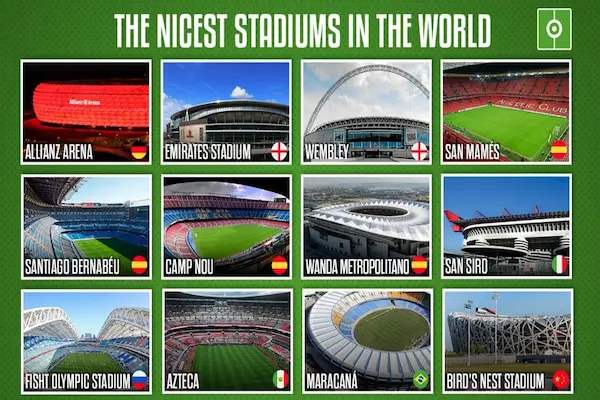
What Makes a Stadium Truly the Best in the World
The criteria that separate a great stadium from a merely functional one are more nuanced than capacity or construction cost alone — and understanding them changes how you evaluate venues across sports and continents.
Atmosphere is the foundational element. A stadium that generates genuine crowd noise — the kind that alters what athletes can hear, disrupts opposing teams’ communication, and creates a physical sensation for everyone inside it — provides a competitive advantage that no amount of luxury amenities can replicate. The most historically significant venues on this list generate that atmosphere naturally, through a combination of design, proximity between fans and the field, and the accumulated weight of decades of important moments played within their walls.
Beyond atmosphere, the best stadiums in the world in 2026 are evaluated on technological innovation, fan experience design, architectural distinction, and their role in the broader cultural identity of the sport they host.
With those criteria established, here is the definitive guide to the world’s finest sports venues across every major discipline.
Best Soccer Stadiums: The Iconic Cathedrals of the Game
Soccer stadiums are evaluated primarily on atmosphere and history — the two factors that separate a venue fans remember their entire lives from one they simply attended once.
Santiago Bernabéu (Madrid, Spain) — The World’s Best Stadium
The Santiago Bernabéu is the most technologically advanced major stadium on the planet following its recently completed renovation — a transformation that turned an already iconic venue into something genuinely futuristic while preserving the historical identity that makes it the home of the world’s most successful club.
The renovation introduced a retractable pitch system that allows the playing surface to be removed and stored on rails beneath the stadium, enabling the Bernabéu to host concerts, events, and non-football fixtures without damaging the grass. A 360-degree video screen wraps the entire interior, creating an immersive visual environment that no other stadium in the world currently replicates at this scale.
The result is a venue that functions simultaneously as a high-technology entertainment complex and the spiritual home of Real Madrid’s 15 Champions League titles — a combination of innovation and historical weight that no competing stadium can match.
- Capacity: Approximately 81,000
- Location: Madrid, Spain
- Key feature: Retractable pitch system; 360-degree interior video screen
- Historical significance: Home to Real Madrid across all 15 of their Champions League title-winning seasons
Estadio Azteca (Mexico City, Mexico) — The Colossus of Saint Ursula
Estadio Azteca holds a unique place in football history that no other venue on earth can claim: it is the first — and currently the only — stadium to host three FIFA World Cup opening matches, a record it will extend further when it stages the 2026 tournament’s opening fixture on June 11.
Known as the “Colossus of Saint Ursula,” the Azteca sits at 2,240 meters above sea level in Mexico City — an altitude that makes it one of the most physiologically demanding playing environments in world football. Visiting teams who are not acclimatized to the altitude routinely underperform in their first Azteca appearances, giving home sides a measurable competitive advantage that has influenced the outcomes of some of the sport’s most significant matches.
The stadium witnessed Diego Maradona’s “Hand of God” goal and the “Goal of the Century” against England in 1986 — two of the most watched individual moments in football history played on the same pitch in the same match — cementing its place as one of sport’s most historically significant venues regardless of its capacity or construction quality.
- Capacity: Approximately 87,500
- Location: Mexico City, Mexico
- Key feature: High altitude (2,240m) creating genuine competitive disadvantage for unacclimatized visitors
- Historical significance: Three World Cup opening matches; host to the “Hand of God” and “Goal of the Century” in 1986
Camp Nou (Barcelona, Spain) — Europe’s Largest Stadium
Camp Nou’s capacity of approximately 99,000 makes it the largest stadium in Europe and one of the largest football venues in the world — a scale that creates a visual impact before a single moment of football has been played.
The noise a packed Camp Nou generates during a decisive Champions League night or an El Clásico against Real Madrid is consistently cited by players from both clubs as one of the most intense competitive environments in the sport. Its size, combined with Barcelona’s historical identity as both a football club and a cultural institution for Catalan identity, gives it a symbolic weight that extends well beyond what any trophy cabinet alone can explain.
Wembley Stadium (London, England) — The Home of Football
The current Wembley Stadium — opened in 2007 on the site of the original “Twin Towers” venue — seats 90,000 and hosts England national team matches, FA Cup finals, and Champions League finals on a rotating basis.
Its 133-meter arch, visible from across large parts of London, has become one of the most recognizable architectural symbols in British sport. The acoustics of a full Wembley crowd — particularly during penalty shootouts — create an atmosphere that visiting players consistently describe as unlike any other European venue.
Best Football Stadiums in the US: Engineering Marvels
American football stadiums have evolved from simple venues into multi-billion dollar entertainment complexes — and the two most impressive examples set a global standard for scale, technology, and the deliberate design of a total fan experience rather than simply a place to watch a game.
SoFi Stadium (Inglewood, California) — The Most Expensive Stadium Ever Built
SoFi Stadium is the most expensive sports venue ever constructed, built at a cost of approximately $5.5 billion — a figure that reflects its ambition to be not just the best NFL stadium but the best entertainment venue of any kind in the world.
Its translucent roof covers the entire seating bowl while allowing natural light to filter through, eliminating the claustrophobic atmosphere of fully enclosed stadiums while protecting fans from weather. The centerpiece of the interior is the “Infinity Screen” — a double-sided 4K video board that circles the entire playing field, creating a continuous visual display visible from every seat in the building at the same time.
SoFi will serve as a primary host for the 2026 FIFA World Cup, including the USA’s opening match on June 12, and will subsequently host events for the 2028 Los Angeles Olympics — a multi-year run of the sport’s most prestigious events that confirms its status as the defining stadium of its generation.
- Capacity: 70,240 (expandable to 100,240)
- Location: Inglewood, California (Los Angeles area)
- Construction cost: Approximately $5.5 billion — the most expensive stadium ever built
- Upcoming events: 2026 FIFA World Cup host; 2028 Olympics venue
- Key feature: Infinity Screen double-sided 4K video board; translucent roof
AT&T Stadium (Arlington, Texas) — “Jerry World” and the Modern Template
AT&T Stadium — universally known as “Jerry World” after Dallas Cowboys owner Jerry Jones, whose vision drove its construction — set the blueprint for the modern NFL mega-venue when it opened in 2009 and remains one of the most recognizable sports facilities in America more than fifteen years later.
Its retractable roof can open fully in favorable weather, and its massive retractable glass doors at each end of the building create the visual impression of the Texas sky merging with the stadium interior — an architectural effect that no other venue has successfully replicated. The center-hung video board was the world’s largest when installed and remains one of the most impressively scaled displays in any sports building.
AT&T Stadium will host the England vs. Croatia group stage match on June 17 during the 2026 World Cup — its first major international soccer fixture and a test of whether its NFL-optimized design translates effectively to the different spatial demands of a World Cup crowd configuration.
- Capacity: 80,000 (expandable to 100,000)
- Location: Arlington, Texas (Dallas area)
- Key feature: Retractable roof, retractable glass end doors, massive center-hung video board
- 2026 World Cup: Host venue for England vs. Croatia (June 17)
The stadiums hosting the 2026 World Cup are central to the experience of following that tournament — and understanding the venues gives you a completely different perspective on how the competition will feel compared to previous editions. Our guide to the top international football tournaments provides the broader context for how these venues fit into the global football calendar.
Best NBA Arenas: Basketball’s Most Iconic Venues
Basketball arenas are evaluated differently from outdoor stadiums — sightlines, proximity between fans and the court, acoustics, and the cultural prestige of the home team all combine to create environments that range from genuinely electric to atmospherically flat regardless of construction quality.
Madison Square Garden (New York City) — The Mecca of Basketball
Madison Square Garden is the most famous indoor arena in the world and the venue most frequently described as the “Mecca of Basketball” — a title it has held since the New York Knicks and their predecessors began making the building synonymous with the highest level of the sport.
Despite being one of the older buildings among the NBA’s current roster of arenas, MSG retains a distinctive advantage that money alone cannot buy: its Manhattan location and the cultural weight of performing in New York City create an atmosphere that current players consistently cite as their favorite venue in the league. The distinctive concave ceiling, the compressed seating bowl that places fans close to the action regardless of price tier, and the accumulated history of the building — from championship fights to playoff moments to concerts that have defined American popular culture — combine to make it irreplaceable.
- Capacity: 19,812 (NBA configuration)
- Location: Midtown Manhattan, New York City
- Home team: New York Knicks
- Defining characteristic: Cultural prestige and Manhattan location; players cite it as their most memorable road venue
Chase Center (San Francisco) — The Gold Standard for Modern Arena Design
Chase Center represents the modern era’s answer to what a premium NBA arena should be — a luxury-first experience built on the philosophy that the fan is a guest rather than merely an attendee, and that every element of the in-arena experience should reflect that distinction.
Its waterfront location in San Francisco’s Mission Bay district, combined with a food and beverage program that reflects the Bay Area’s exceptional culinary culture, massive high-resolution scoreboards, and premium sightlines from virtually every seat, makes it the gold standard for the post-pandemic generation of arena construction.
- Capacity: 18,064 (NBA configuration)
- Location: Mission Bay, San Francisco
- Home team: Golden State Warriors
- Defining characteristic: Luxury fan experience; waterfront location; best-in-class food and facilities
Best MLB Stadiums and Baseball Parks Worth Knowing
The best MLB stadiums and best major league baseball stadiums combine architectural character with the spatial generosity that baseball’s unique geometry demands — and the finest examples in the league have become destinations in their own right, drawing fans who are as interested in the park itself as in the game being played inside it.
- PNC Park (Pittsburgh, Pennsylvania): Consistently ranked the best ballpark in MLB for its combination of intimate sightlines, a downtown skyline view over right field, and the Roberto Clemente Bridge providing a pedestrian walkway that creates a pre-game ritual unlike any other park in the league. Its relatively modest capacity keeps the experience personal in ways that larger venues cannot replicate.
- Fenway Park (Boston, Massachusetts): The oldest active MLB stadium, opened in 1912, and home to the “Green Monster” — the 37-foot left field wall that has defined the physical character of Red Sox baseball since the park’s founding. Its age and idiosyncrasy make it the best baseball field in MLB for historical atmosphere.
- Oracle Park (San Francisco, California): The San Fran stadium perspective that the 49ers’ Levi’s Stadium lacks for intimacy — Oracle Park’s waterfront location on McCovey Cove, where home run balls regularly splash into the bay, makes it one of the most distinctive visual environments in American sport. Among the best MLB fields for pure aesthetic character.
- Globe Life Field (Arlington, Texas): The best major league stadium for comfort in extreme weather — its fully enclosed, climate-controlled interior makes it the only MLB venue that can guarantee a controlled temperature experience regardless of Texas summer heat.
- Coors Field (Denver, Colorado): Among the best minor league baseball stadiums as a comparison point for what a park can mean to a city, Coors Field’s downtown location and mountain views have made it integral to Denver’s urban identity since it opened in 1995.
The best MLB park debate among baseball fans carries the same intensity as any rivalry discussion — and the stadiums themselves often define the fan experience of following a team as much as the team’s results do.
Other World-Class Stadiums Worth Visiting
Beyond the headline venues already covered, several other stadiums deserve recognition for specific aspects of the fan experience that make them genuinely world-class in their context.
- Allianz Arena (Munich, Germany): The home of Bayern Munich, whose exterior can be illuminated in red, white, or blue depending on which team is hosting. Its inflatable ETFE plastic exterior panels create a visual effect at night that makes it one of the most recognizable stadium silhouettes in the world.
- Melbourne Cricket Ground (Melbourne, Australia): The largest stadium in the Southern Hemisphere and the spiritual home of Australian Rules football and cricket simultaneously — a dual-sport cultural institution that no equivalent venue in the Northern Hemisphere can match for sheer historic significance across two completely different sports.
- Lumen Field (Seattle, Washington): The Seattle Seahawks football stadium that holds the Guinness World Record for loudest outdoor stadium — a designation earned through the specific design of the building’s roof structure, which traps crowd noise and amplifies it in a way that creates genuine competitive difficulty for opposing offenses trying to communicate at the line of scrimmage.
- Levi’s Stadium (Santa Clara, California): The San Fran 49ers stadium that hosts major events including Super Bowls and international soccer fixtures, with a rooftop park and solar panel installation that make it one of the most environmentally designed venues in professional sports.
The stadiums where football’s greatest moments have been produced are inseparable from the stories of the clubs and players who created those moments — and understanding that connection is at the heart of our guide to the biggest football rivalries of all time and why certain venues have become permanently associated with the history of those feuds.
Want to explore more of the world of sport beyond the venues? Our sports section covers everything from the greatest clubs and players to tournament guides and rivalry histories — all the context that gives these iconic stadiums the stories worth telling.