Most Successful Football Clubs in History
Advertisements
Advertisements
The biggest clubs in football history did not earn that status through a single trophy or a lucky season.
They built it across decades of sustained excellence, generational squads, and the kind of institutional culture that transforms individual talent into collective dominance.
From Real Madrid’s unmatched European record to Bayern Munich’s stranglehold on the Bundesliga and the global icons of South American football, this is the definitive conversation about which organizations have genuinely shaped the sport at its highest level.
Whether you follow European club football closely, want to understand where the Champions League giants sit in the broader global picture, or simply want to know which teams have won the most across every major competition on earth, this guide provides the complete, historically grounded answer.
Read through to the end and you will have a clear framework for understanding how the world’s most successful football clubs compare — and why certain organizations have consistently produced trophies while others with similar resources have not.
See Also
- Greatest football rivalries of all time
- Best football stadiums in the world
- Top international football tournaments to follow
- Football rules explained for beginners
- Most popular football teams in the world
How to Measure the Biggest Clubs in Football History
Defining the most successful football clubs in history requires settling on what success actually means — because the answer looks significantly different depending on whether you prioritize domestic league titles, continental trophies, global tournament records, or a weighted combination of all three.
A club that has won twenty domestic titles in a smaller league occupies a fundamentally different category from one that has won fifteen Champions League titles in Europe’s most competitive continental competition. Equally, a South American club that has won the Copa Libertadores seven times — defeating the best squads on a continent that has produced a disproportionate share of football’s greatest individual players — deserves recognition on any honest global list.
The framework used throughout this guide combines three assessment layers: raw trophy volume at the highest available level, the competitive weight of those competitions relative to the strength of the field, and the sustained consistency that separates clubs with one or two dominant periods from those whose excellence has spanned multiple decades.
With that framework established, here is the complete picture of the biggest clubs football has ever produced.
The Biggest Clubs in European Football: Champions League Dominance
In European football, the UEFA Champions League is the ultimate measure of a club’s standing in the sport’s global hierarchy — and no competition in the world is more difficult to win consistently, given that it brings together the best-resourced, most talented squads from the strongest domestic leagues on the planet.
The gap between the most successful club in Champions League history and every other organization is not just large — it is historically extraordinary.
Real Madrid — The Greatest Club in Football History
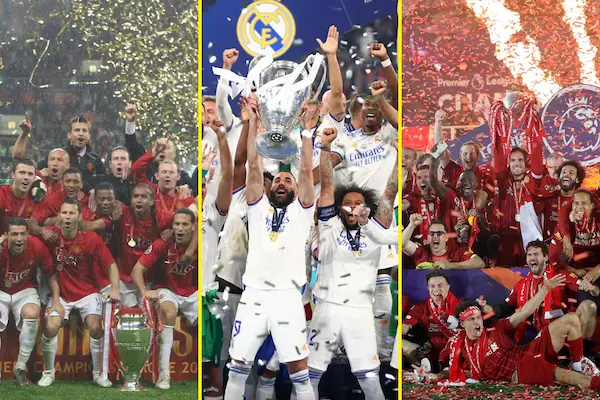
Real Madrid’s 15 Champions League titles place them “on a different planet” from every other club in European football history — a phrase that is not hyperbole but a straightforward description of the mathematical gap between their record and the nearest competitor’s.
Fifteen titles. The next closest club has seven. Real Madrid has more than double the European titles of any other team in the history of the competition — a record built across seven decades, through multiple complete generations of squads, under managers from vastly different eras of tactical thought, and in the face of increasingly competitive fields as the competition expanded and broadcasting revenue allowed more clubs to compete for elite talent.
Their most recent title came in 2024, cementing the 15th and confirming that the organization’s ability to produce Champions League winners is not a historical relic but an ongoing institutional capacity. As of 2026, they remain among the favorites for the next European crown.
Their La Liga record — 35 domestic titles — adds a domestic dimension to their European dominance that makes the case for Real Madrid as the most successful club in football history essentially unchallengeable on pure trophy volume.
- Champions League titles: 15 (more than double the nearest competitor)
- La Liga titles: 35
- Annual revenue: €1.16 billion — the highest of any football club in the world
- Defining era: The Di Stéfano era of the 1950s–60s, the Galácticos era of the 2000s, and the Zidane-managed period of four titles in five years between 2016 and 2022
AC Milan — Seven European Titles and Historical Dominance
AC Milan’s seven Champions League titles place them second in European history — a record built on two distinct periods of continental dominance separated by nearly two decades.
Their late-1980s and early-1990s squads, managed by Arrigo Sacchi and then Fabio Capello, played some of the most organized and tactically innovative football the European game had ever seen, winning back-to-back European Cups in 1989 and 1990 with a level of collective efficiency that influenced how the sport was coached globally for the following decade.
Their early-2000s resurgence under Carlo Ancelotti — featuring players like Maldini, Shevchenko, Pirlo, and Kaká — produced two more Champions League titles in 2003 and 2007, reconfirming Milan as one of the sport’s elite organizations despite a sustained dry spell in the 2010s that temporarily obscured their historical standing.
- Champions League titles: 7
- Serie A titles: 19
- Defining characteristic: Two distinct periods of European dominance separated by tactical innovation that influenced the global game
Liverpool and Bayern Munich — Six Titles Each, Consistent Finalists
Liverpool and Bayern Munich share six Champions League titles each — a figure that places both clubs firmly among the biggest clubs in European football history, even if it represents roughly half of what Milan has won at the continental level.
Liverpool’s European record is defined as much by their presence on the biggest stage as by their victories: ten Champions League finals in total represent a level of sustained continental relevance that reflects genuine institutional quality beyond raw winning percentages. Their five-title period between 1977 and 1984 under Bob Paisley remains one of the most concentrated periods of European dominance any English club has achieved, and their 2019 and near-misses since have confirmed the organization’s continued ability to compete at the continental summit.
Bayern Munich’s European record — six titles across five decades — reflects the same consistency of organizational excellence that has produced eleven consecutive Bundesliga titles between 2013 and 2023. Their record of appearing in eleven Champions League finals is the joint-highest in the competition’s history, meaning their six victories come from one of the most competitive finals records of any club in the tournament.
- Liverpool Champions League titles: 6 (10 finals appearances)
- Bayern Munich Champions League titles: 6 (11 finals appearances)
- Bayern Bundesliga titles: 33 domestic titles, including 11 consecutive between 2013–2023
Understanding what it takes for a club to sustain this level of continental dominance over multiple generations is part of what makes following the biggest rivalries in football so compelling — because the greatest clubs define themselves most clearly against the specific opponents that have challenged them most persistently.
Most Successful Football Clubs Outside Europe: The Continental Giants
The biggest clubs in football history are not exclusively European — and any honest global ranking of the most successful organizations in the sport’s history must account for the Copa Libertadores record holders, the CONCACAF champions, and the Asian clubs whose dominance within their respective confederations mirrors what Real Madrid has achieved in Europe.
Independiente — The “King of Cups” in South America
Independiente holds the record for the most Copa Libertadores titles of any club in South American football history — seven in total — earning the nickname “King of Cups” that has been associated with the Argentine club since their period of peak continental dominance.
The Copa Libertadores is South America’s equivalent of the UEFA Champions League, bringing together the champion clubs from the continent that has produced Pelé, Maradona, Messi, Ronaldo, and an extraordinary concentration of the sport’s greatest individual talent across its history. Winning it seven times represents a continental achievement that bears comparison to the European records of the clubs listed above.
Boca Juniors — Six Libertadores Titles and Global Recognition
Boca Juniors is the most globally recognized South American club and the holder of six Copa Libertadores titles — second only to Independiente in South American continental success.
Their rivalry with River Plate in the Buenos Aires Superclásico is widely considered the most emotionally intense club derby in world football, and their international profile — built on decades of producing exceptional players who subsequently moved to European leagues — has made them one of the sport’s most recognizable brands globally.
Club América — Most Successful Club in North American Football
Club América is the most successful team in Mexican football history and the record holder for CONCACAF Champions Cup titles with seven triumphs — making them the North and Central American equivalent of the continental giants listed above.
Their domestic dominance in Liga MX, combined with their continental record, places them firmly among the biggest clubs in football history when the assessment extends beyond the European context that tends to dominate global football conversation.
Urawa Red Diamonds — Asia’s Continental Contenders
Urawa Red Diamonds from Japan are one of the most successful clubs in AFC Champions League history, having won the continental title multiple times and consistently contended for further titles throughout their history as one of Asia’s most resourced and ambitious football organizations.
Their success reflects the broader development of football infrastructure and investment across Asia — a pattern of growth in the sport’s global footprint that connects directly to the story of how the game has evolved worldwide, as explored in our guide to the evolution of football around the world.
The Weighted Success Argument: Which Clubs Were the Biggest in Each Era
Historians and analysts who study football’s competitive history have long argued that a trophy in the Premier League or La Liga carries more weight than an equivalent title in a smaller domestic competition — and applying that logic to a multi-era global assessment produces a different top three than raw trophy counting alone.
When success is weighted by the competitive strength of each competition, the historical tier of the biggest clubs in the “Big Five” European leagues resolves into three clear tiers.
Tier 1: Real Madrid — Unmatched Volume and Weight Combined
No weighting system changes Real Madrid’s position at the top of any honest assessment of the biggest clubs in football history. Their 15 Champions League titles in the strongest continental competition, combined with 35 La Liga titles in one of the world’s two strongest domestic leagues, produces a trophy record that is unmatched in both raw volume and competitive weight simultaneously.
Tier 2: Bayern Munich — The Bundesliga Monopoly
Bayern Munich’s eleven consecutive Bundesliga titles between 2013 and 2023 represent a period of domestic dominance with virtually no historical parallel in a major European league — a stretch of consistency that demonstrates institutional quality rather than simply a temporary advantage of squad talent.
Combined with their six European titles and their record of consistent Champions League final appearances, Bayern occupy a secure second tier in any weighted assessment of European football’s most successful clubs.
Tier 3: Manchester United and Liverpool — Alternating English Dominance
Manchester United and Liverpool share the third tier of this assessment — two clubs whose alternating periods of English dominance, combined with meaningful European records, place them above all other clubs in the history of the Premier League era.
Manchester United’s 20 league titles — including thirteen Premier League titles under Alex Ferguson between 1993 and 2013 — represent the most concentrated period of domestic dominance any English club has achieved in the modern game. Liverpool’s European record of six Champions League titles and their Premier League dominance during the Klopp era confirm their status as the English club whose current form most closely matches their historical standing.
| Rank | Club | Why They Qualify | Key Trophy Record |
|---|---|---|---|
| 1 | Real Madrid | UCL volume + La Liga consistency | 15 UCL, 35 La Liga |
| 2 | AC Milan | Two eras of European dominance | 7 UCL, 19 Serie A |
| 3 | Bayern Munich | 11-year Bundesliga stranglehold + 6 UCL | 6 UCL, 33 Bundesliga |
| 4 | Liverpool | 10 UCL finals, modern Premier League dominance | 6 UCL, 20 league titles |
| 5 | Manchester United | Ferguson era Premier League monopoly | 3 UCL, 20 league titles |
| 6 | Barcelona | 5 UCL titles; tiki-taka era redefining football | 5 UCL, 27 La Liga |
| 7 | Independiente | South American record — 7 Copa Libertadores | 7 Copa Libertadores |
| 8 | Boca Juniors | 6 Copa Libertadores; global recognition | 6 Copa Libertadores |
| 9 | Club América | North America’s most successful club | 7 CONCACAF Champions Cup |
| 10 | Juventus | 36 Serie A titles; 2 UCL wins | 2 UCL, 36 Serie A |
What Separates the Biggest Clubs From the Rest
After reviewing every major club across every continent and every era, the single factor that most consistently separates the truly biggest clubs from highly successful but ultimately limited organizations is institutional stability — the ability to rebuild winning squads after losing key players, adapt tactically across different eras, and maintain the organizational culture that produces elite-level football even when the individual talent on the roster is not at its historical peak.
Real Madrid’s ability to win the Champions League with radically different squads across seven decades demonstrates this capacity more clearly than any other club in the sport’s history. Bayern Munich’s decade-long Bundesliga dominance reflects it in the domestic context. Liverpool’s ability to produce competitive European squads under managers as different as Bob Paisley in the 1970s and Jürgen Klopp in the 2020s confirms that the club’s culture rather than its roster is its most durable competitive asset.
The next generation of players entering their prime in 2026 will determine which of these clubs extend their historical records and which new organizations begin building the kind of sustained success that eventually places them in this conversation — because football’s greatest clubs are always works in progress, not finished monuments.
Final Verdict: The Biggest Club in Football History
The answer is Real Madrid — and it is not close.
Fifteen Champions League titles. Thirty-five La Liga titles. The world’s highest-revenue football club. The organization that has consistently produced the sport’s greatest moments in its most prestigious competition across more decades than any other team has managed at that level.
Every other club on this list has a legitimate case for inclusion based on their specific record in their specific context. But if you had to name the single biggest club in the history of football by any measure that combines competitive weight, sustained excellence, and global cultural impact simultaneously, the answer has been the same since the competition’s founding — and remains the same heading into 2026.
Some clubs win trophies. Real Madrid wins eras.
The history of football’s biggest clubs is inseparable from the players who defined them — and our sports section covers everything from individual player rankings and rivalry histories to the tournaments where these clubs have built their legendary reputations, game by unforgettable game.