History of the FIFA World Cup
Advertisements
Advertisements
The history of the FIFA World Cup is the story of how a modest 13-team invitational held in Uruguay in 1930 became the most-watched sporting event on the planet — a journey spanning nearly a century, 22 editions, and enough defining moments to fill a library.
From the first world champions lifting a trophy on a July afternoon in Montevideo to Lionel Messi finally securing his in Qatar in 2022, the World Cup has always been where football history is written.
Understanding how the tournament evolved — its formats, its host nations, its greatest milestones, and the nations that have dominated it — gives every future match an entirely new level of meaning and context.
Whether you are new to the sport or a lifelong follower of the FIFA World Cup by year, this complete guide covers everything worth knowing about where it all started and how it became what it is today.
See Also
- Most successful football clubs in history
- Best football stadiums in the world
- Greatest football rivalries of all time
- Best football players in the world right now
- How football evolved around the world
The Origins: How the FIFA World Cup Started
The start of the World Cup traces back to 1930 in Uruguay, chosen as the inaugural host nation for two powerful reasons: they were the reigning back-to-back Olympic football gold medalists, and 1930 marked the centenary of Uruguayan independence — a symbolic alignment that FIFA president Jules Rimet felt made the country the ideal birthplace for the new global competition.
Before the start of world cup soccer as a formal competition, international football was played primarily through the Olympic Games, which restricted eligibility to amateur players. The founding of a professional World Cup was designed to remove that limitation and bring the best footballers on earth into a single tournament without restriction.
The format of the inaugural edition was an invitational — there were no qualifying rounds, and FIFA simply extended invitations to national associations around the world. The response from Europe was lukewarm at best: many European teams declined to make the long, expensive transatlantic voyage by boat, leaving a field that was heavily weighted toward South American nations.
Only 13 nations competed in the first edition, a fact that makes it feel almost unimaginably small compared to the 48-team field that will take the stage in 2026. The tournament was played entirely in Uruguay, with matches spread across several venues in Montevideo, culminating in a final at the Estadio Centenario — a stadium built specifically to host the occasion.
Uruguay defeated Argentina 4–2 in that inaugural final on July 30, 1930, becoming the first FIFA world cup champions in history and establishing South America as the spiritual home of the tournament’s opening chapter.
History of the FIFA World Cup: Key Eras and Milestones
As the tournament grew from a regional invitational into a global phenomenon, several specific moments changed the World Cup’s character permanently — not just in terms of competitive results, but in how the event was experienced by fans around the world.
| Year | Milestone | Impact |
|---|---|---|
| 1954 | First Televised World Cup | Turned the tournament into a global media phenomenon for the first time. |
| 1958 | The Rise of Pelé | A 17-year-old Pelé led Brazil to their first title, launching an era of dominance. |
| 1970 | “The World Cup of Firsts” | First color broadcast; introduction of yellow and red cards and substitutes. |
| 1982 | Expansion to 24 Teams | Allowed for greater representation from Africa and Asia for the first time. |
| 1986 | Maradona’s Magic | Famous for both the “Hand of God” and the “Goal of the Century” against England. |
| 1998 | Expansion to 32 Teams | Established the format used throughout most of the 21st century. |
| 2022 | First Winter World Cup | Held in Qatar; Lionel Messi secured the trophy for Argentina at the third attempt. |
The 1954 tournament in Switzerland deserves special recognition as the turning point that transformed the FIFA World Cup from an important football competition into a genuine global cultural event — the moment when hundreds of millions of people around the world could watch the same match simultaneously for the first time.
The 1970 edition in Mexico is widely considered the most aesthetically beautiful World Cup in history, producing Brazil’s all-time great team and introducing the innovations in officiating and broadcast quality that define how the modern tournament looks and operates.
The Two FIFA World Cup Trophies
One of the lesser-known facts in the history of the FIFA World Cup is that there have actually been two completely different trophies awarded to world champions across the tournament’s 22 editions.
The Jules Rimet Trophy (1930–1970)
The original trophy was commissioned for the inaugural 1930 tournament and officially named “Victory” — though it was subsequently renamed the Jules Rimet Trophy in 1946 in honor of the FIFA president who founded the competition and campaigned tirelessly for its creation.
The Jules Rimet Trophy was made of gold-plated sterling silver and depicted Nike, the Greek goddess of victory. It stood 35 centimeters tall and weighed approximately 3.8 kilograms.
FIFA’s rules at the time stated that any nation winning the World Cup three times would be allowed to keep the trophy permanently. Brazil reached that milestone with their third title in 1970 and took permanent possession of the original prize — though the story ended badly when the Jules Rimet Trophy was stolen from a display in Rio de Janeiro in 1983 and has never been recovered.
This makes the FIFA world cup historical ball set and memorabilia from the pre-1970 era among the rarest and most historically significant objects in the sport.
The FIFA World Cup Trophy (1974–Present)
The current FIFA World Cup Trophy was designed by Italian sculptor Silvio Gazzaniga and first awarded at the 1974 tournament in West Germany.
It depicts two human figures holding up the Earth, standing 36.8 centimeters tall and weighing 6.175 kilograms. The base contains malachite rings, and the trophy itself is made entirely of 18-carat solid gold — making it one of the most physically valuable sporting prizes in existence.
Unlike its predecessor, the current trophy cannot be kept permanently by any winning nation. World cup champions FIFA receive a gold-plated replica to take home, while the original remains in FIFA’s custody between tournaments.
List of FIFA World Cup Winners: Most Successful Nations in History
Only eight nations in the history of the FIFA World Cup have ever won the tournament — a remarkably small number given that 22 editions have been played across nearly a century of competition.
Brazil stands alone at the top of the list of football world cups won, with five titles and the unique distinction of being the only nation to have participated in every single tournament since 1930.
| Titles | Nation | Years Won |
|---|---|---|
| 5 | Brazil | 1958, 1962, 1970, 1994, 2002 |
| 4 | Germany | 1954, 1974, 1990, 2014 |
| 4 | Italy | 1934, 1938, 1982, 2006 |
| 3 | Argentina | 1978, 1986, 2022 — current defending champions |
| 2 | France | 1998, 2018 |
| 2 | Uruguay | 1930, 1950 |
| 1 | England | 1966 |
| 1 | Spain | 2010 |
The list of world cup football champions tells a story about concentration of footballing power — eight nations across 22 tournaments, with Brazil alone accounting for nearly a quarter of all titles ever awarded.
Argentina’s position as three-time world cup football champion and current defending champion makes them one of the most compelling stories heading into 2026, where a fourth title would move them level with Germany and Italy on the all-time list.
The Complete List of FIFA World Cup Hosts
Hosting the FIFA World Cup is one of the most prestigious honors in international sport, and the list of FIFA World Cup hosts reflects the tournament’s geographic expansion from its South American origins to its current status as a truly global event.
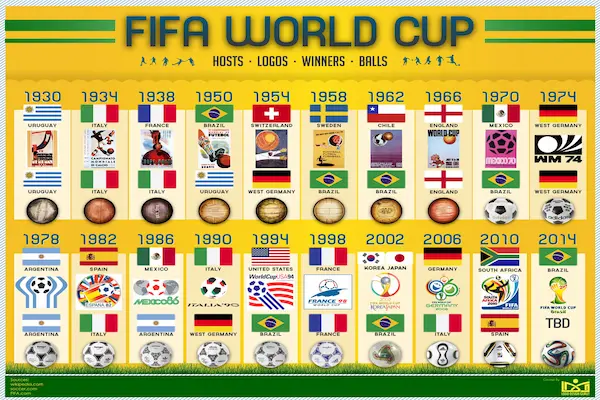
- 1930: Uruguay
- 1934: Italy
- 1938: France
- 1950: Brazil
- 1954: Switzerland
- 1958: Sweden
- 1962: Chile
- 1966: England
- 1970: Mexico
- 1974: West Germany
- 1978: Argentina
- 1982: Spain
- 1986: Mexico
- 1990: Italy
- 1994: United States
- 1998: France
- 2002: South Korea / Japan (joint hosts)
- 2006: Germany
- 2010: South Africa
- 2014: Brazil
- 2018: Russia
- 2022: Qatar
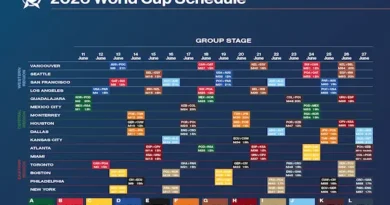
- 2026: United States, Canada, Mexico (joint hosts)
The 2026 edition is particularly notable in the context of this list — it marks the first time three nations have shared hosting duties simultaneously, and the second time the United States has hosted the tournament after the hugely successful 1994 edition that generated record attendance figures that still stand today.
Understanding what it means to play in front of home crowds across 16 iconic North American stadiums helps explain why several nations who qualify in 2026 will have structural crowd support advantages — a dynamic explored in depth in our guide to the best football stadiums in the world and the role they play in tournament outcomes.
The World Cup by Year: Match 52 and the Modern Format
Tracking the FIFA World Cup by year reveals a consistent pattern of expansion and format evolution that mirrors the growth of football itself as a global sport.
When the format expanded to 32 teams in 1998, it introduced the group stage and knockout bracket structure that most modern fans grew up watching — a format that remained unchanged for 24 years before the 2026 expansion to 48 teams created an entirely new stage in the competition’s architecture.
The concept of “Match 52” has become shorthand in tactical circles for the World Cup final itself — the 52nd and final match of the traditional 32-team format. In the new 48-team structure, the tournament extends to 104 matches total, meaning the final becomes Match 104 on the schedule — a number that reflects just how dramatically the scale of the competition has grown since those 13 nations gathered in Montevideo in 1930.
The next FIFA World Cup locations after 2026 will be Spain, Portugal, and Morocco in 2030 — marking the tournament’s centenary edition — followed by Saudi Arabia in 2034, confirming that the FIFA world cup’s geographic reach will continue expanding into new markets throughout the coming decade.
The FIFA World Cup’s Greatest Moments in History
Across 22 editions and nearly a century of competition, a handful of moments stand apart as the ones that defined what the World Cup means — not just as a football tournament, but as a cultural event that transcends sport.
- 1950 — The Maracanazo: Uruguay defeating Brazil 2–1 in the decisive final match at Rio de Janeiro’s Maracanã stadium, in front of an estimated 200,000 spectators. Widely described as one of the greatest upsets in sporting history.
- 1958 — Pelé’s Emergence: A 17-year-old Pelé scoring twice in the final against Sweden, announcing himself to the world as the sport’s first global superstar and beginning Brazil’s era of World Cup dominance.
- 1966 — England’s Only Title: Geoff Hurst’s hat-trick in the final against West Germany at Wembley remains the only World Cup hat-trick in a final in the tournament’s history.
- 1970 — Brazil’s Greatest Team: Pelé, Jairzinho, Tostão, and Rivelino producing what many historians still consider the most technically beautiful football ever played at a World Cup, defeating Italy 4–1 in the final.
- 1986 — Maradona’s Duality: Diego Maradona scoring the “Hand of God” goal and the “Goal of the Century” in the same quarter-final match against England — arguably the single most discussed 11 minutes in World Cup history.
- 2022 — Messi’s Moment: Lionel Messi winning the World Cup at his fourth and final attempt, defeating France in a penalty shootout in one of the most dramatic finals ever played, finally settling the greatest-of-all-time debate for millions of fans.
These moments resonate so powerfully because the World Cup stage amplifies everything — the pressure, the history, the stakes, and the consequences. Understanding the deepest rivalries in football history adds the context that makes each of these moments feel inevitable in retrospect.
What the History of the FIFA World Cup Tells Us About 2026
Every pattern in World Cup history points toward 2026 being the most consequential edition of the tournament since it expanded to 32 teams in 1998.
The expansion to 48 teams will produce new champions from nations that have never previously won — or at minimum, semi-finalists from regions that have historically been eliminated in the round of 16. Morocco’s semi-final run in 2022 was the clearest preview of what the new format will amplify.
The next FIFA World Cup locations spreading the tournament across three North American host nations means the list of FIFA world cup hosts is entering a new era of multi-nation co-hosting that will likely define the format for future editions as well.
And with Spain ranked first in the world, Argentina defending their championship, and Brazil arriving with their strongest squad in over a decade, the world cup champions FIFA crowns in July 2026 will emerge from the most competitive field the tournament has ever assembled.
The young generation of football players who will define this tournament are already writing their names into a story that began in Montevideo in 1930 — and will keep being told for as long as football is played.
Final Thoughts: Why the FIFA World Cup’s History Matters
The history of the FIFA World Cup is not just a record of results and trophies — it is the story of how football became the world’s language, how rivalries between nations were settled and intensified on the same pitch, and how individual moments of genius became part of the shared memory of billions of people across every continent.
From those first 13 nations crossing the Atlantic in 1930 to the 48 that will compete across three countries in 2026, every edition of the tournament has added a new chapter to a story that shows no signs of reaching its conclusion.
The World Cup does not just reflect football’s history — it creates it.
Ready to explore more of what makes football the world’s most compelling sport? Our sports section covers everything from player rankings and tournament previews to club histories and rivalry guides — all the depth you need to follow the game at every level.