How to Get a Motorcycle License in the US: Step-by-Step
Getting your Motorcycle License in the US can feel confusing at first, because every state has its own DMV rules and terminology.
Advertisements
Motorcycle License App
Best free app to simulate the theory and practical driving test.
Advertisements
You will remain on the same site
But the overall path is simple once you see it step-by-step, and you can set yourself up to pass on the first try.
Notice: this content is independent and has no affiliation, sponsorship, or control by any entities mentioned.
That includes DMVs, DPS offices, safety course providers, private schools, and any third-party platforms you may find online.
How to Get a Motorcycle License in the US (Step-by-Step)
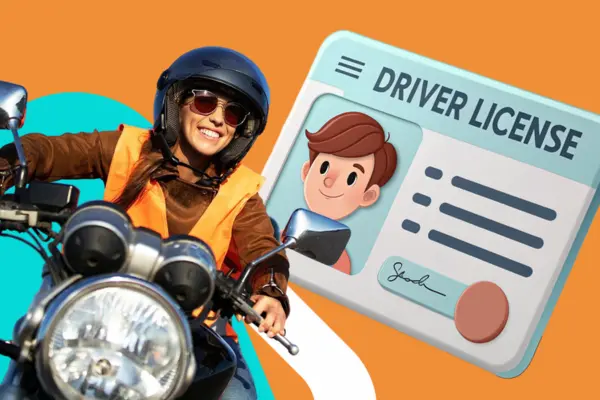
If your goal is to ride legally on public roads, you typically need either a motorcycle endorsement on your driver’s license or a standalone motorcycle license.
The exact name and process vary by state, but the checkpoints below are the ones you will see almost everywhere.
Who can apply and what you usually need
Most states require you to meet minimum age rules, prove identity and residency, and meet basic vision standards.
If you are under 18, you may also need a parent or guardian signature and extra training requirements.
- You have a valid ID and can provide proof of residency.
- You can pass a vision screening at the DMV or bring acceptable documentation.
- You meet your state’s minimum age to hold a motorcycle permit or endorsement.
- You are ready to study your state’s motorcycle handbook and traffic laws.
Step-by-step: the most common Motorcycle License path
Use this as your roadmap, then confirm the exact steps on your state DMV website before you book anything.
- Read your state’s motorcycle handbook and focus on lane positioning, braking, and hazard awareness.
- Apply for a motorcycle learner permit by taking the knowledge test at the DMV.
- Practice in low-risk environments while following permit restrictions in your state.
- Schedule training, like a state-approved safety course, if that option is available to you.
- Choose your “testing route,” either a DMV skills test or an approved course waiver route.
- Bring the required documents, pay the fees, and complete any required checklists.
- Pass the motorcycle skills test or submit course completion paperwork if your state accepts it.
- Get your motorcycle endorsement or standalone license added to your credential and confirm it is printed correctly.
That is the “spine” of the process, and once you understand it, the rest is just details your state adds on top.
Motorcycle License options: permit, endorsement, or standalone license
Many riders say they are “getting a motorcycle,” but the legal part is really about which credential you hold and what it allows.
Understanding the differences helps you pick the fastest, safest route for your situation.
Motorcycle learner permit
A permit is usually the first step, and it lets you practice with restrictions while you build skills.
Common restrictions can include no passengers, no night riding, and sometimes no freeway riding, depending on your state.
The permit phase is where many new riders gain confidence, because you can practice fundamentals without the pressure of a road test right away.
Motorcycle endorsement on your driver’s license
In many states, you do not receive a separate “motorcycle-only” card, because the motorcycle privilege is added as an endorsement.
If you have heard someone say “get motorcycle endorsement,” they are usually talking about this add-on.
Once the endorsement is active, you can ride within your state’s rules, just like you drive with a regular license.
Standalone motorcycle license
If you do not have a regular driver’s license, some states allow a motorcycle-only credential, but requirements can be stricter.
This can be a good option in specific cases, but it may limit you if you later decide to drive a car.
Tests you may face for a Motorcycle License
Most states use two layers of evaluation: a knowledge test and a skills test.
If you prepare for each one intentionally, the process becomes less stressful and far more predictable.
The knowledge test
The written test usually covers traffic signs, right-of-way, safe following distance, impairment risks, and motorcycle-specific strategies.
Motorcycles have unique risk patterns, so expect questions about visibility, lane choice, and how road surfaces affect traction.
- Study your state’s motorcycle handbook instead of relying only on generic online quizzes.
- Memorize high-risk situations like intersections, left-turn conflicts, and sudden stops.
- Practice “what would you do” scenarios, because many questions are judgment-based.
The skills test
The skills test often checks low-speed control, braking, swerving, and turning precision.
It is less about speed and more about calm control, clean technique, and consistent head-and-eye movement.
- Practice smooth clutch and throttle control until you can ride slowly without wobbling.
- Train emergency braking with progressive pressure, keeping the bike stable and upright.
- Get comfortable turning your head and looking through the turn, not down at the ground.
Motorcycle License training: when classes are worth it
Many states allow a training course to replace the DMV riding test, but that depends on local rules.
Even when it does not replace the test, formal instruction can shorten your learning curve dramatically.
What you gain from a safety course
A quality course gives you structure, feedback, and controlled practice that is hard to replicate alone.
You also get coached repetition on the exact skills that often appear on a DMV riding exam.
- Guided practice for braking, turning, swerving, and slow-speed maneuvers.
- Coaching that helps you fix habits early, before they become expensive mistakes.
- A safer environment for first-time riders than learning only on public streets.
Terms you might see while searching for training
Depending on your state, you might see training described with different labels in listings and search results.
Examples include “dmv motorcycle class,” “dmv motorcycle course,” and “motorcycle license training,” even when the DMV does not run the class directly.
You may also see “dps approved motorcycle safety course” in states where the Department of Public Safety handles licensing functions.
Always confirm that the provider is recognized by your state and that the completion certificate is accepted for licensing purposes.
What to bring to the DMV for your Motorcycle License appointment
Walking in prepared prevents the most frustrating delays, especially if your office is appointment-only.
Your state will publish an official checklist, but these items are commonly requested.
- Proof of identity, such as a state-approved ID document.
- Proof of residency, which may include mail, a lease, or other acceptable documents.
- Your current driver’s license, if you are adding an endorsement.
- Payment method for fees, because some locations have limited options.
- Any permit paperwork, course completion documents, or waiver forms, if applicable.
If you are using a course waiver route, confirm whether the DMV needs the original completion card, a digital record, or both.
Small details like that vary widely, and they can be the difference between a quick visit and a rescheduled appointment.
Motorcycle License costs and timeline: what to expect
Fees vary by state, and costs can include permit fees, testing fees, license issuance fees, and optional training costs.
Instead of hunting for one “national price,” treat your DMV’s fee schedule as the only source of truth for your location.
Timeline also varies, because some states require you to hold a permit for a minimum period before you can test.
If you are motivated and your state allows it, training plus testing can sometimes move quickly, especially if appointments are available.
Common mistakes that slow people down
- Booking a road test before practicing low-speed control and emergency braking consistently.
- Assuming any class certificate counts for licensing without checking state acceptance.
- Arriving without complete documents and having to return another day.
- Practicing only fast riding and neglecting the slow maneuvers that exams focus on.
The fastest path is usually the most organized path, not the most rushed path.
International motorcycle license: what it really means in the US
You will often see searches for “international motorcycle license,” but that phrase can be misleading.
In practice, riders are usually talking about an International Driving Permit motorcycle translation paired with a valid home-country license.
Some people also search “international motorbike license,” “international bike license,” or even “international bike licence,” depending on spelling habits.
The key idea is that you generally need a valid underlying license, and acceptance rules depend on the state and the situation.
If you are visiting the US, check your state’s requirements and your rental company’s rules before you assume anything will be accepted.
If you are moving to the US, you will typically need to follow the state process for a Motorcycle License rather than relying on international paperwork long-term.
Watch for scams and confusing third-party branding
Some websites market “international licenses” in ways that sound official, but are not connected to US state licensing systems.
You might also run into business names in search results like “motorcycle licensing llc,” which could be a private company and not a government office.
When in doubt, treat your state DMV or DPS website as the authority, and view third-party sites as informational only.
How to find help near you without wasting time
When you are ready to train, you will probably search locally, because convenience matters when you are practicing multiple days.
That is why phrases like “motorcycle school near me,” “motorcycle endorsement near me,” and “motorcycle endorsement classes near me” are so common.
You might also search “motorcycle endorsement class,” “motorcycle endorsement course,” “motorbike licence training,” “motorcycle licence training,” or “motorcycle license near me,” depending on your keyboard habits.
What to check before you pay for any class
- Confirm the course is state-approved if you want it to count toward licensing or waivers.
- Ask whether they provide a bike and helmet for beginners, or if you must bring your own gear.
- Check class size, because smaller groups usually mean more coaching per student.
- Verify the schedule and rain policy, because weather can impact training days.
- Look for transparent policies on rescheduling, refunds, and completion requirements.
If your primary goal is a license quickly, you want a provider that is recognized and organized, not just one with flashy marketing.
Quick FAQ: Motorcycle License questions people ask most
Do I need a Motorcycle License if I only ride a scooter?
That depends on engine size and your state’s definition of motorcycle or motor-driven cycle.
Check your DMV classification rules before you assume a scooter is exempt.
Can I skip the permit step?
Some states allow direct testing paths for certain ages or situations, but many require a permit first.
Your DMV will spell out whether holding a permit is mandatory before the skills test.
Is a safety course always required?
Not always, but it is often strongly recommended, and sometimes required for minors or for certain licensing paths.
Even when optional, training can increase your odds of passing and reduce your risk on the road.
What if I fail the motorcycle skills test?
Most states let you retake it, but there may be a waiting period or additional fee.
Use the failure as feedback, practice exactly what went wrong, and come back calmer and better prepared.
Do I need special insurance to test?
If you bring your own motorcycle to a DMV test, many states require the bike to be registered and insured.
Confirm test-day vehicle requirements before you arrive, because rules vary.
What is the best “first bike” for passing the test?
For test day, lighter and more manageable bikes often make low-speed maneuvers easier.
Choose something you can control confidently, because confidence shows up as smoothness and precision.
Wrap-up: your next best move
If you follow the step-by-step plan, your Motorcycle License stops being a mystery and becomes a checklist you can finish.
Start by reading your state handbook today, then decide whether you will test at the DMV or through a state-approved training route.
Either way, focus on control, calm practice, and safety, because that is what helps you pass and what keeps you riding for years.